







About Us
The station, the city, and the people behind this site
Hello and welcome to the Southampton Weather website - a private, independently run weather station providing live, continuously updated conditions for Southampton, Hampshire, and the surrounding Solent area.
Our Weather Station
This private weather station was assembled and set up in stages during early 2008, and has been in more or less constant development ever since. It sits very close to the centre of Southampton, giving a genuinely local read on the weather affecting the city and the wider Southampton Water area.
The station is made up of several different sets of wireless sensors, each covering a different aspect of the weather. The most important are paired anemometers (for wind speed and direction), a self-tipping, self-emptying rain gauge accurate to 0.1mm, dual digital barometers and thermometers, soil and moisture sensors, cloud-detection equipment, UV sensors, psychrometers, and a range of digital hygrometers - all positioned to give the most accurate readings possible.
Data from the sensor array is sent to our main station computer in Southampton every two seconds, then on to this website, which updates live, every few seconds, 24 hours a day, seven days a week. The web servers themselves are securely hosted in air-conditioned, temperature-and-voltage-controlled racks in Telehouse, London.
About Southampton

Photo: Lewis Clarke (CC BY-SA 2.0, via Geograph) - Cunard's Queen Mary 2 at Southampton, the ocean liner's home port
Southampton is a vibrant, modern city on the south coast of England, offering a warm welcome to visitors from all over the world. It's the closest city to the New Forest, sitting roughly halfway between Portsmouth and Bournemouth, at the point where the River Test and River Itchen meet the top of Southampton Water - with the River Hamble joining a little further south.
The city has always been closely tied to maritime history. It's long been a leading cruise port, with its heyday in the first half of the 20th century, and today it remains home to many of the world's great liners as well as being a major container port - among the largest and busiest on the UK's south coast. Southampton was the departure point for the Mayflower in 1620, and in 1912 it was the starting point for RMS Titanic's ill-fated maiden voyage. The Southampton International Boat Show is held here every year and remains a highlight of the UK's sailing calendar.
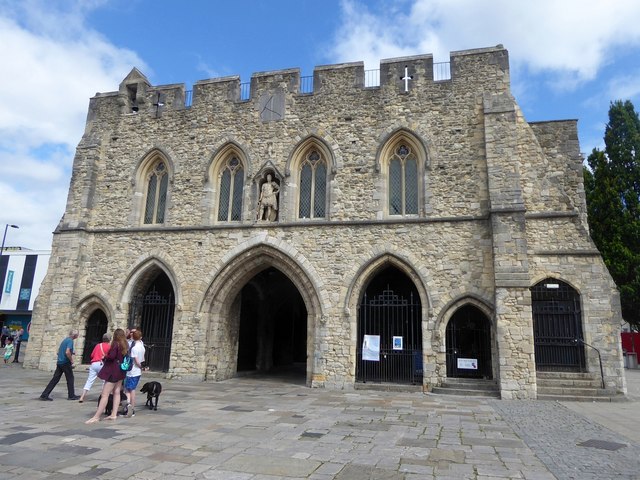
Photo: Rob Farrow (CC BY-SA 2.0, via Geograph) - The Bargate today, viewed along the pedestrianised High Street
The city also has a proud sporting culture: Southampton Football Club play at St Mary's Stadium, and Hampshire Cricket's home ground - long known as the Ageas Bowl - is now the Utilita Bowl following a change of sponsor.
Look up in the city centre and you'll also spot the Bargate itself - Southampton's medieval gatehouse, originally built around 1180 as the main entrance through the city walls. It's a Grade I listed building and a Scheduled Ancient Monument, and the small covered bell visible at the top left is the city's old curfew and alarm bell, dating from 1605.
The Bargate looks quite different today than it did even a decade or two ago. The road that used to run either side of it is long gone - the whole area is now pedestrianised, so you can no longer drive around it - and the tired 1980s Bargate Shopping Centre that once crowded right up against it has been demolished entirely. That site is now being redeveloped as the "Bargate Quarter", a near-£100 million mixed-use scheme of new homes, shops and leisure space, which will also uncover stretches of Southampton's medieval town walls that had been hidden behind the old shopping centre for around 30 years. The gate itself remains exactly where it's always been, still standing at the heart of the modern city centre - just with a lot more open space, and a lot less traffic, around it these days.
Southampton's Climate
Southampton generally has mild winters, helped by its closeness to the sea. February is the coldest month, with an average minimum of around 2.6°C, and also sees the most air-frost days of the year - though still fewer than the UK average. January usually has the most days with meaningful rainfall, and winter as a whole sees more of them than any other season, even though the heaviest rainfall totals actually fall in autumn.
Temperatures start to pick up from March, with long-term highs around 11°C, rising to about 17°C by May. Coastal sea breezes tend to keep maximum temperatures a little lower here than further inland. Sunshine hours increase noticeably from April onwards and run well above the UK average, while spring rainfall is comparatively low, with May usually the driest month of the season.
July and August are Southampton's hottest months, with average daytime highs of around 22.4°C and 22.3°C respectively. Southampton also gets more sunshine hours in summer than in any other season, and rainfall is roughly half the national average - July is typically the driest month of the year, with only around 42mm of rain.
September usually stays mild, with an average daytime maximum of about 19.8°C - some 3°C above the UK average for the month. Autumn brings the highest rainfall totals of any season, with November typically the wettest month. Air frost is rare in October (roughly once every two years) but becomes far more likely by November.
A record that stood for 50 years
On 28 June 1976, a temperature of 35.6°C was recorded at Mayflower Park, right here in Southampton - equalling a record set in London back in 1957 and making it, for exactly half a century, the UK's official June temperature record. That record finally fell in June 2026, when 37.7°C was recorded at Strumpshaw Hill, Norfolk, during what the Met Office confirmed as England's warmest June on record. A genuinely local piece of UK weather history - and a reminder of how much has changed in the fifty years since.
Credits and Thanks
Many of the weather station's sensors and equipment were supplied by Oregon Scientific (UK) Ltd, Maidenhead, Berkshire, along with Davis Instruments Ltd, One Wire Ltd, Boltek, Campbell Scientific, and Dallas Semiconductors.
The servers this site and the weather station run on were supplied by Posinfo Ltd - thanks to Jonathan for all the help and advice over the years. Routers were supplied by Linksys/Netgear/Cisco, with networking support from Solwise Ltd.
Special thanks go to Kevin Reed for the original common website PHP framework, and to Mike Challis for the wind-rose generator, online mapping, Theme Switcher, and CSS styling help. A number of articles in our weather information section were originally supplied courtesy of Wikipedia. Thanks also to Ken True for the AJAX conditions/dashboard integration, and to YR.no and the Norwegian Meteorological Institute for the original flash-forecast interface. More complete credits can be found on our Credits page.
Disclaimer
Throughout this website we link to third-party sites. A link does not imply any endorsement of that site, or of the information, products, or services it offers. This is a private weather station run on a non-profit basis - we do our best to provide accurate, up-to-date weather information, but running a site like this is a complicated, time-consuming affair, and if something outside our control affects our output, we can only apologise and fix it as quickly as we can. All information is provided "as is"; we take no responsibility for erroneous data or inaccurate forecasts, and this site should not be relied on for professional purposes. Please don't base any decision that could affect the safety of people or property on our weather information alone.
And please note: we can't always predict the future - if it rains, it rains.