








Synoptic Pressure Charts
Met Office MSLP analysis & forecasts • Courtesy Wetterzentrale.de • All times UTC
Synoptic pressure charts — often called “fax charts” — show mean sea-level pressure (MSLP), weather fronts, and isobars across Europe and the Atlantic. They are the classic tool used by meteorologists to understand the big-picture pressure pattern and how it will evolve. From these charts you can follow a frontal system from the Atlantic all the way to Southampton over the course of several days.
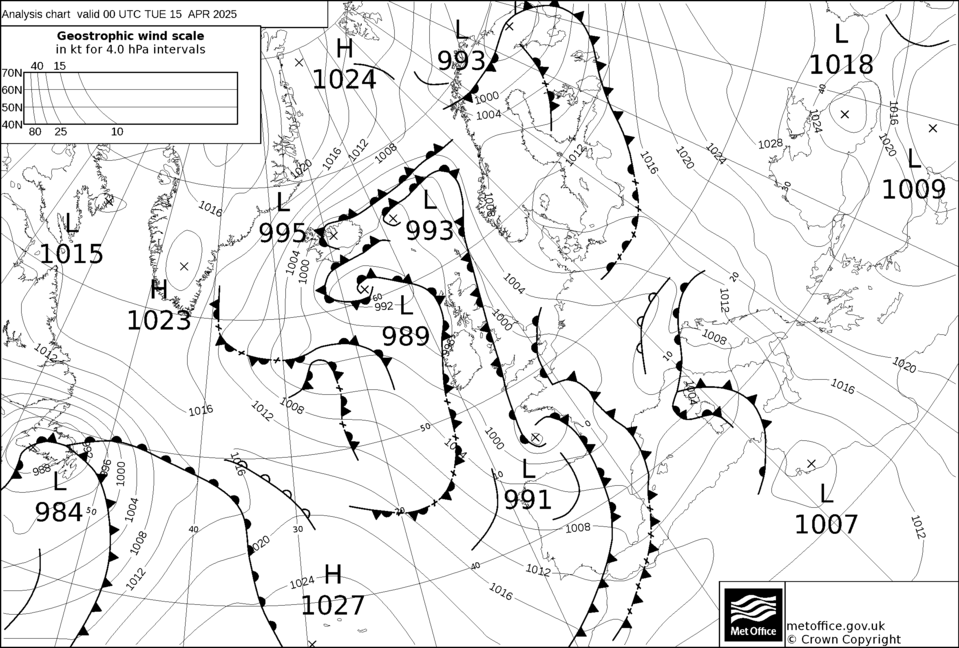
Met Office MSLP Charts
Official Met Office mean sea-level pressure analysis and forecasts over Europe. Select a time step:
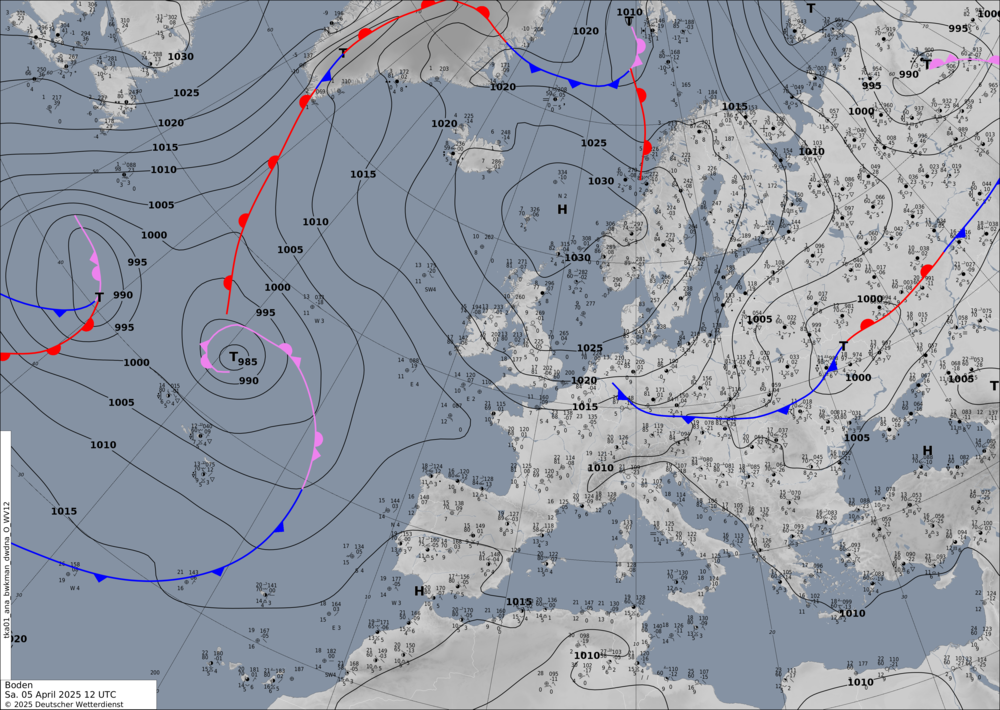
DWD (German Weather Service) MSLP Charts
European surface pressure analysis and forecasts from Deutscher Wetterdienst (DWD) — Germany’s national meteorological service. Useful for comparison with the Met Office analysis, particularly at longer time ranges.
How to Read a Synoptic Chart
|
Isobars are lines joining points of equal atmospheric pressure, measured in millibars (mb) or hectopascals (hPa) — the two are identical. They are drawn at 4 mb intervals. The closer the isobars, the stronger the wind. Wide spacing means light winds. High pressure (H) — also called an anticyclone — brings settled, often dry weather. Winds circulate clockwise around a high in the northern hemisphere. Highs in summer bring warm sunshine; in winter they can bring fog and frost. Low pressure (L) — a depression or cyclone — brings cloud, wind and rain. Winds circulate anticlockwise around a low. Most of the UK’s unsettled weather arrives with Atlantic depressions tracking eastward. |
Cold fronts are shown as a blue line with triangular points. Cold air is pushing in behind the system; as the front passes, temperatures drop and skies can clear rapidly. Cold fronts can produce heavy showers and squalls. Warm fronts are shown as a red line with semicircles. Warm air is advancing over colder air ahead of the depression, typically bringing a long period of increasing cloud and steady rain before the temperature rises. Occluded fronts are shown as a purple line with alternating triangles and semicircles, formed when a cold front catches up with a warm front in a maturing depression. The weather can be complex and variable. |
Normal sea-level pressure around the UK ranges from about 970 mb in a deep Atlantic depression to 1040 mb or higher in a strong anticyclone. The standard average is 1013 mb. A deep low of 960 mb or below tracking towards southern England would bring very strong winds.